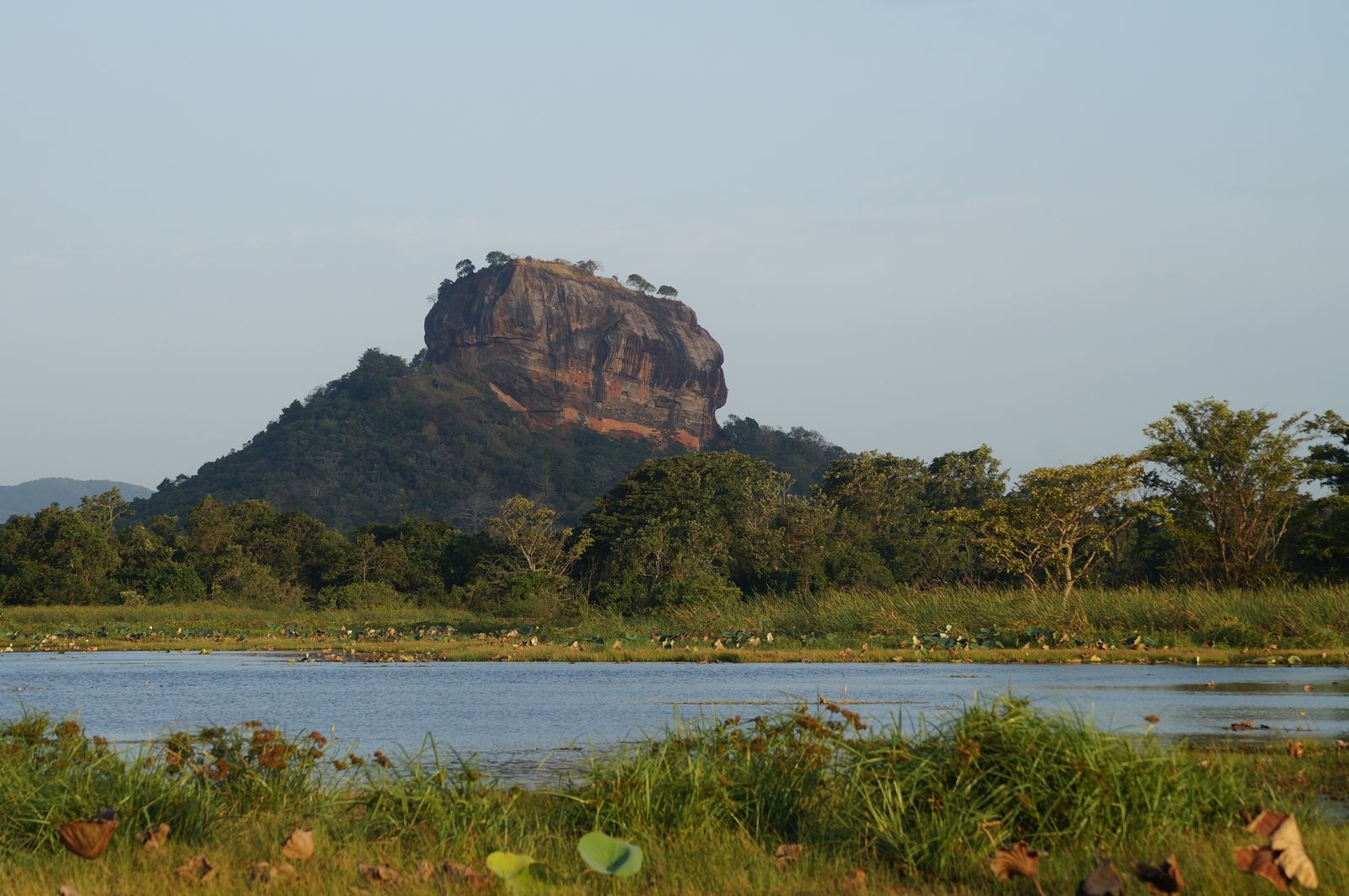
The first time I climbed Sigiriya I was twenty-four, carrying a guest’s water bottle, and completely unprepared for the fact that the hard part is not the steps. It is the heat, the bottleneck at the lion’s paws, and the queue that forms there at nine in the morning.
Sigiriya rock climbing is the most photographed hour of most Sri Lankan holidays, and also the one people plan worst. They arrive at ten, buy a ticket in full sun, and reach the frescoes when the rock is already radiating heat back at them.
I have taken guests up this rock for eight years. This guide is what I tell them the night before. It covers the real route stage by stage, the current ticket prices, the hours nobody agrees on, and the alternative for non-climbers.
Every fact below comes from the UNESCO listing for the Ancient City of Sigiriya, the Central Cultural Fund’s published price table, or Sri Lanka Tourism. Where official channels contradict each other I say so instead of picking the tidiest version.
Sigiriya Rock Climbing — The Quick Answer
Sigiriya is a 180-metre granite rock in the Cultural Triangle with a fifth-century palace on its summit. Sigiriya rock climbing covers roughly 1,200 steps in two concentrated flights, with a spiral staircase detour for the frescoes, and takes most visitors about three hours from gate to gate.
Difficulty is moderate. If you can climb four flights of stairs at home without stopping, you can do this comfortably. The exposure on the final metal staircase is what surprises people, not the length of the climb.
| At a glance | Detail |
|---|---|
| Height | 180 m from the plain (UNESCO figure) |
| Steps | About 1,200 in total |
| Time needed | 2.5 to 3 hours, gardens to summit and back |
| Foreign adult ticket | US$35, charged in rupees at the fund’s daily rate |
| Concession ticket | US$20 for children 6 to 12, SAARC passports and student cards |
| Opening hours | Published as anything from 05:00 to 07:00 in the morning |
| Best window | 07:00 to 09:00, or the first hour the gate opens |
| Difficulty | Moderate, no scrambling or technical climbing |
That last table row about opening hours is the one to read twice. Three credible sources publish three different sets of times, and I will come back to it with a workable rule for Sigiriya rock climbing.
Sigiriya Rock Fortress — What You Are Climbing
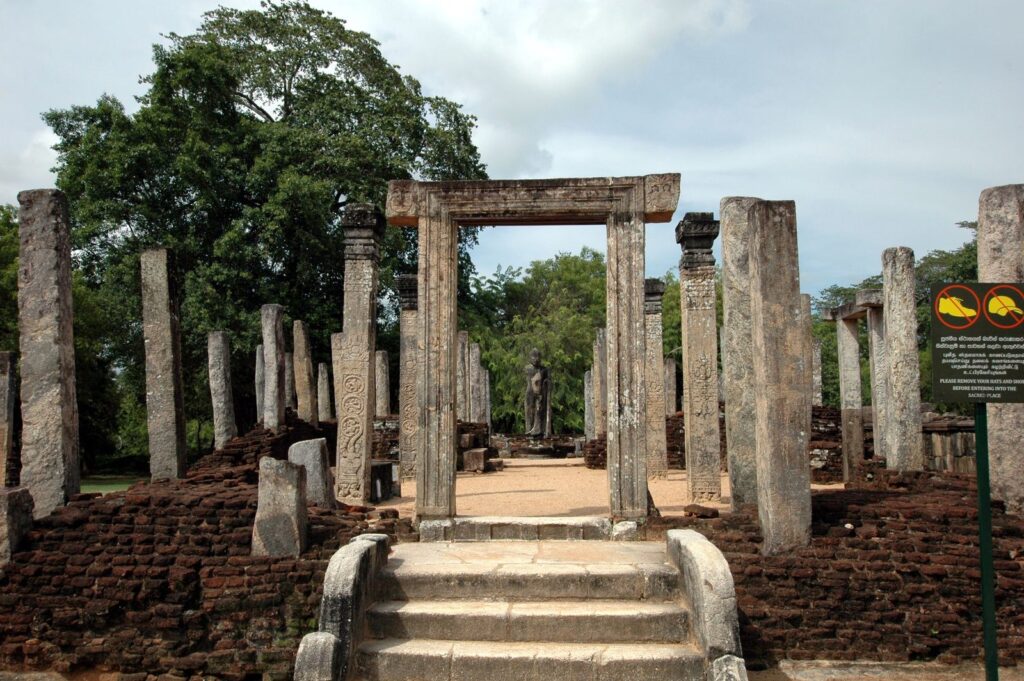
Sigiriya rock fortress is not a single building but a walled city wrapped around and over a granite outcrop. The plan is concentric: gardens at the base, boulder terraces on the slopes, painted galleries partway up, and a palace precinct on the flat summit. Everything the Sigiriya rock climbing route passes through is part of that single design.
The UNESCO World Heritage listing describes the site simply, as the ruins of the capital built by King Kassapa I on a granite peak standing some 180 metres high. That figure is measured from the surrounding plain rather than from sea level, which is why the rock looks taller than 180 metres from the car park.
What surprises guests is the size of the top. It is not a pinnacle you stand on for a photograph. It is a plateau of ruined halls, bathing pools and terraces, with jungle on every side. Nothing in the Sigiriya rock fortress prepares you for that scale.
King Kasyapa and the Eighteen-Year Palace
In 477 AD Kassapa took the throne at Anuradhapura from his father, King Dhatusena, in a coup that the old chronicles describe in grim detail. His half-brother Moggallana, the rightful heir, fled to India and began raising an army.
Kassapa then moved his capital onto this rock and ruled from it for eighteen years. The water gardens, the painted gallery and the lion gateway belong to that single, paranoid, extraordinarily ambitious building programme. Almost nothing on the Sigiriya rock climbing route would exist without that decision.
In 495 Moggallana returned with an army from India. The story runs that Kassapa’s war elephant turned aside on the battlefield, his troops read it as an omen and deserted, and he killed himself rather than be captured alive.
After Kasyapa — Monastery, Jungle and Rediscovery
Moggallana moved the capital back to Anuradhapura, and Sigiriya lived on as a Buddhist monastery for several centuries before the jungle took it. It stayed lost long enough that a British officer, Jonathan Forbes, described the overgrown summit in 1831 as a curiosity rather than a palace.
Systematic excavation began in the 1890s, and UNESCO inscribed the Ancient City of Sigiriya as a World Heritage Site in 1982. Recording and conserving the Sigiriya rock climbing route has been a working project ever since. The Sigiriya Museum beside the entrance, included in your ticket, explains the hydrology and the painting technique better than any signboard on the rock.
Why It Is Called Lion Rock
Sinhagiri means Lion Rock. The last staircase to the summit once ran through the open mouth of a colossal lion. It was built from brick and plaster against the north face, so visitors walked into the animal to reach the king.
The lion did not survive the centuries. Two enormous carved paws and a stretch of brickwork are all that remain, and they are still the most photographed object on the entire Sigiriya rock climbing route.
Sigiriya Rock Climbing — The Route, Stage by Stage
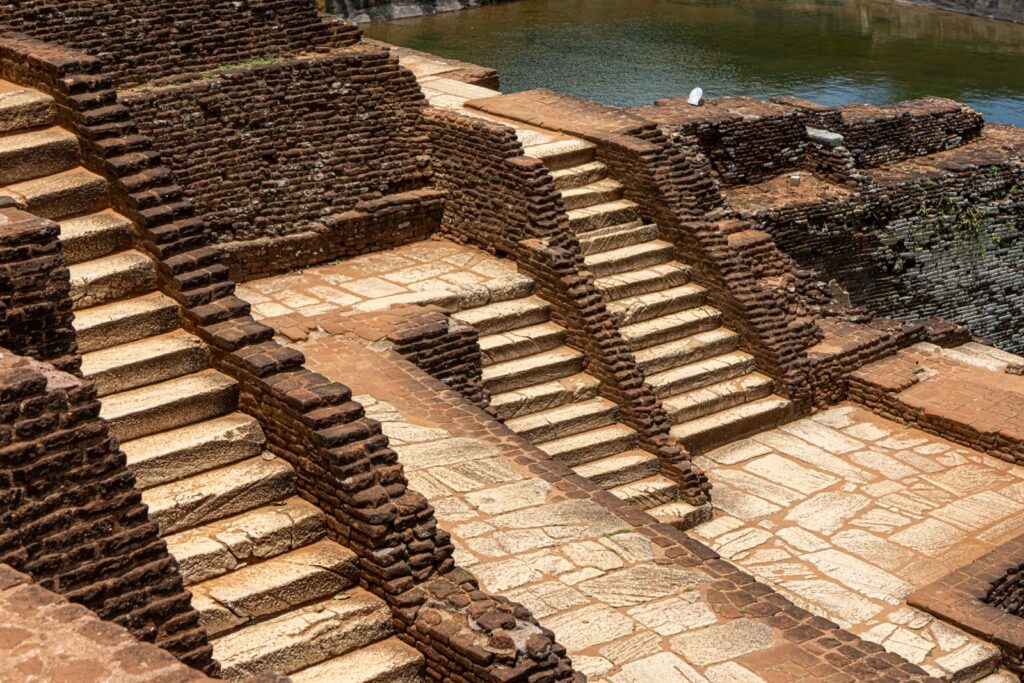
The climb reads best as six stages, because each one has a different floor, a different crowd and a different reason to stop. Knowing what comes next is what turns a hot scramble into a morning you actually enjoy, which is most of what good Sigiriya rock climbing advice amounts to.
In total the circuit is about 1,200 steps, gardens to summit and back down again. Most of those steps sit in two concentrated flights rather than spreading evenly up the rock face, which is why Sigiriya rock climbing feels short until it suddenly does not.
Stage 1 — Sigiriya Water Gardens
Sigiriya water gardens occupy the flat western approach, and they are among the oldest surviving landscaped gardens anywhere in the world. Symmetrical pools, island pavilions and terraced beds all run along a single axis towards the rock.
The fountains are fed by underground channels and still run after heavy rain, which is why a wet-season visit is not the loss people expect. Give this stage fifteen unhurried minutes. Most visitors rush it and then wonder why the site is a World Heritage listing at all, which is a shame, because Sigiriya rock climbing begins here.
Stage 2 — Boulder Gardens and the Terraces
Past the gardens the path threads between natural boulders with carved drip ledges and rock-cut seats, then climbs a long stone staircase squeezed between two giant boulders. This is where Sigiriya rock climbing proper starts, and where the first good shade ends.
Look left for the cobra-head rock and the cave shelters that monks used after the palace was abandoned. There is no view at this stage, and that is fine. The view arrives later, all at once, and it is worth letting Sigiriya rock climbing build to it.
Stage 3 — Sigiriya Frescoes and the Spiral Staircase
Halfway up, a modern spiral staircase turns off the main path into a sheltered pocket in the rock face. It is the only way to see the Sigiriya frescoes, and it works as a dead end in practice. You go up, you look, you come back down the same stairs.
The paintings are fifth-century celestial maidens, the apsaras, in ochre, yellow and green on a plaster ground. Only a fraction of the original painted surface survives, and photography is restricted inside the gallery. Read the signs before you raise a phone, because this is the one part of Sigiriya rock climbing where a flash can do damage.
The queue at this stairwell is short at opening and long after nine. That single fact is the main reason I tell guests to take the first hour of the day for Sigiriya rock climbing rather than the second.
Stage 4 — Sigiriya Mirror Wall and the Graffiti
Past the stairwell that holds the Sigiriya frescoes, the path runs alongside the Sigiriya mirror wall. It is a plastered parapet, once polished so finely that the king could see his own reflection in it. Its real value today is what other people scratched into the surface, which is the detail most Sigiriya rock climbing guides walk straight past.
Those scratched verses, known as the Sigiri graffiti, were written between roughly the sixth and fourteenth centuries by travellers, soldiers and pilgrims. They are among the oldest surviving examples of Sinhala poetry, and they are the reason the wall is protected rather than cleaned.
Do not add to them. The temptation is real on a bare stretch of plaster. It is also a heritage offence with a fine attached, and no morning of Sigiriya rock climbing should end that way.
Stage 5 — The Lion’s Paws and the Final Staircase
The path emerges onto a wide terrace guarded by the two lion’s paws, then turns into a series of steep metal staircases bolted to the exposed rock. This is the section people remember, and the point where Sigiriya rock climbing stops feeling like a walk.
There is no shade here and no alternative route. The staircase is narrow enough that two-way traffic has to stop and shuffle. That is why this terrace becomes a bottleneck between nine and eleven each morning, and why so much Sigiriya rock climbing advice is really timing advice.
If heights bother you, watch the step in front of you and keep both hands on the rails. The exposure is genuine but brief, perhaps ten minutes of climbing in total, and it is the section guests worry about most before Sigiriya rock climbing.
Stage 6 — The Summit and the Palace Ruins
The summit is a plateau of ruined foundations: a royal hall, bathing pools cut straight into the rock, terraces, and a limestone seat that may have been a throne. It is far larger than the photographs suggest, and there is nowhere at all to hide from the sun once Sigiriya rock climbing is behind you.
Look north-west for the real reward of Sigiriya rock climbing. The water gardens spread out below in their full geometry, the forest runs to the horizon, and Pidurangala Rock sits opposite like a smaller sibling.
Twenty minutes at the top is enough for most people, and an hour is not too long if you carried enough water up. There are no toilets and no vendors on the summit, which surprises almost everyone who has not read a Sigiriya rock climbing guide before.
How Hard Is Sigiriya Rock Climbing?
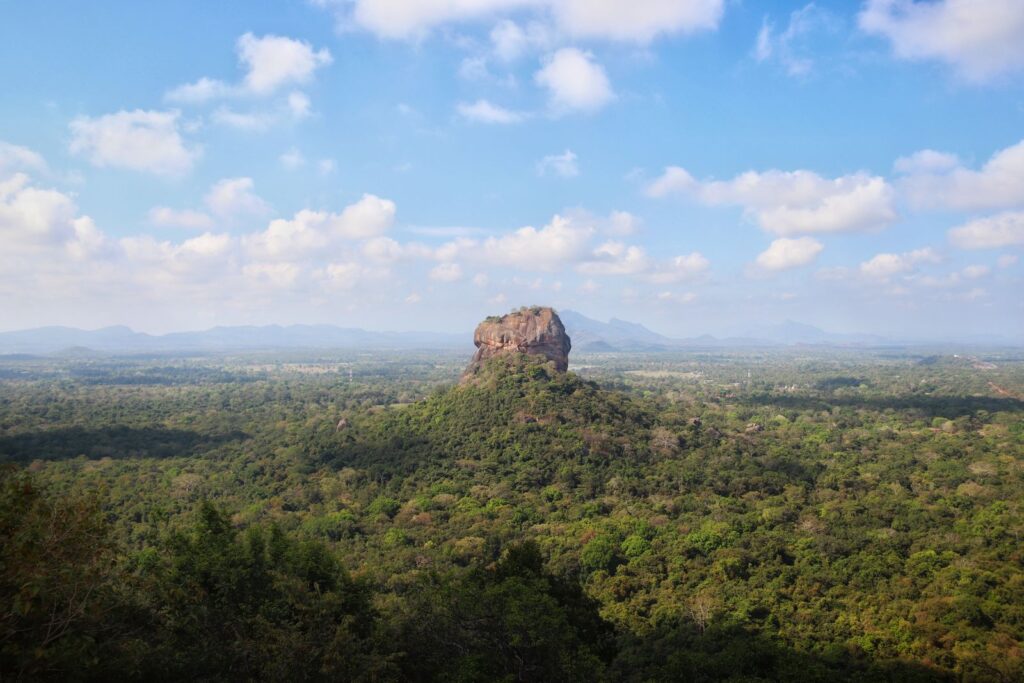
Moderate, and shorter than the step count suggests. The 1,200 steps are real, but they are broken by terraces, galleries and flat garden paths, so you are never climbing continuously for very long.
My rule of thumb for guests is a simple one. If you can climb four flights of stairs at home without stopping to rest, you will manage Sigiriya in under two hours of moving time. If stairs leave you breathless, budget three hours and start at opening, and treat the summit as optional rather than the point of Sigiriya rock climbing.
| Who you are | What to expect | My advice |
|---|---|---|
| Average adult | 1.5 to 2 hours moving; heat is the real challenge | Start at opening, carry 1.5 litres |
| Children aged 6 to 12 | Fine, but short legs slow the final staircase | Count the steps, bring a snack for the summit |
| Older travellers with good knees | Manageable; handrails on nearly every flight | Two hours with rests, skip the midday window |
| Fear of heights | The final metal staircase is exposed; the rest is enclosed | Decide at the lion’s paws, not at the car park |
| Knee problems | Descending is harder than climbing | Take the stairs sideways; Pidurangala is no easier |
| Limited mobility | The summit is genuinely unreachable | Gardens, museum and Dambulla instead |
Sigiriya rock climbing is not a technical climb. There is no rope, no scrambling and no rock face to touch; every metre of it is a staircase, a ramp or a path through the trees.
The one place that changes is the final staircase, where the treads are steep, the wind is real and the drop opens up behind you. Turn around at the lion’s paws if that is not for you. There is no shame in stopping, and the rest of Sigiriya rock climbing is still worth the ticket.
Sigiriya Tickets and Entrance Fee 2026
Sigiriya is the most expensive single ticket on a normal Sri Lankan itinerary, and the one most often bought with the wrong money. Here is the published structure for Sigiriya rock climbing, which the Central Cultural Fund updates as the rupee moves.
| Visitor | Price |
|---|---|
| Foreign adult | US$35 |
| Foreign child aged 6 to 12 | US$20 |
| SAARC passport holder, adult or child | US$20 |
| Child under 6 | Free |
| Sri Lankan adult | LKR 120 |
| Sri Lankan child | LKR 60 |
| Museum only, without the rock | US$6 |
Those figures come from the Central Cultural Fund’s price table published on 14 October 2026. The fund sets prices in US dollars and charges them in rupees at its own daily rate, so the rupee cost of Sigiriya rock climbing changes from week to week.
On that 14 October rate of 336 rupees to the dollar, a US$35 adult ticket came to LKR 11,760. Prices include 18% VAT, and the Sigiriya Museum at the entrance is included in the rock ticket.
Bring your passport. The concession ticket for children aged 6 to 12, SAARC passport holders and international student card holders is checked at the counter, and a photocopy will not be accepted.
Two rules catch people out. The ticket is single entry on the day it is issued, with no refunds, so leaving for lunch means paying for Sigiriya rock climbing twice. Buying online through the Central Cultural Fund’s e-ticket service saves the payment queue, but an online order is still exchanged for a paper ticket at the counter.
Sigiriya rock climbing is also the one ticket where the museum really is worth the extra twenty minutes. The scale models of the water hydraulics explain the gardens better than a guide can from memory.
Sigiriya Opening Hours — Why the Sources Disagree
This is the most useful section I can write for you, because the official answer depends on who you ask. Three credible sources publish three different sets of hours for the same Sigiriya rock climbing site.
| Source | Hours it publishes |
|---|---|
| Central Cultural Fund visitor information | 07:00 to 17:00, with ticket counters on the same hours |
| Department of Archaeology site listing | 06:30 to 17:30 |
| Site and operator pages updated October 2026 | Gates 05:00 to 18:30, tickets sold 05:00 to 17:00, frescoes close 17:45 |
None of these is simply wrong. The gate, the ticket office and the fresco gallery are managed as three separate things. The hours shift with the season and with staffing, which is a nuisance for anyone planning Sigiriya rock climbing months ahead.
The practical consequence is important: you cannot build an itinerary around being on the summit at sunrise. Plan to be at the counter at 06:45 and treat anything earlier as a bonus.
If the gate is open at five and selling tickets, you have gained two cool hours and the best light of the day. If it is not open, you have lost fifteen minutes and a coffee.
Sunset is the safer bet for atmosphere, and the light on the Sigiriya water gardens in the last hour before closing is better than most visitors expect.
The Best Time to Climb Sigiriya — Month by Month, Hour by Hour
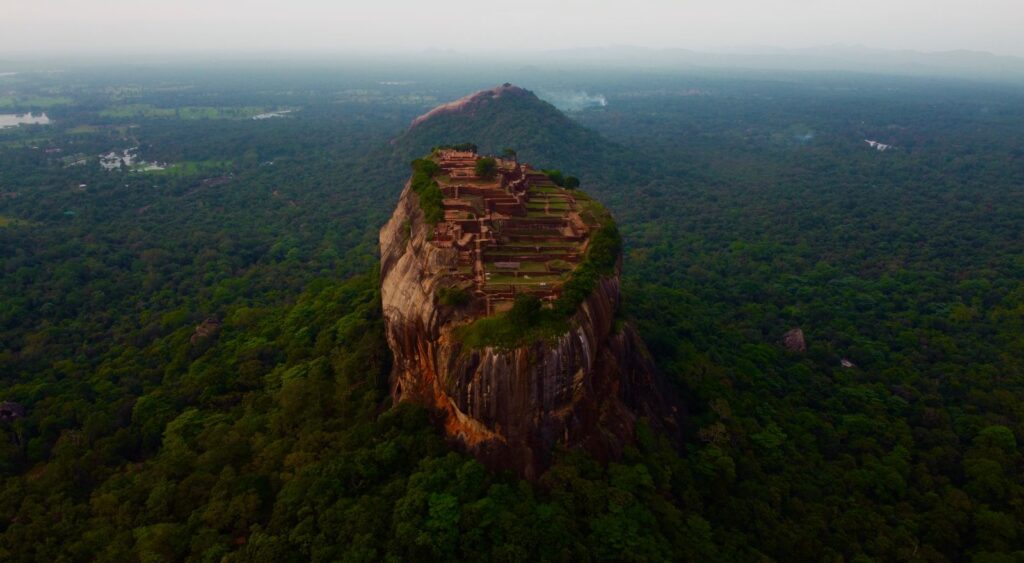
Sigiriya sits in Sri Lanka’s dry zone, which is why it is one of the few places on the island that works in almost any month. The question for Sigiriya rock climbing is less about rain than about heat and crowds.
The Best Months — January to March and June to August
January to March is the driest and kindest stretch, with cooler mornings and the clearest summit views of the year. June to August is hotter but also dry, and it is when the Cultural Triangle fills with families on school holidays.
April and September are shoulder months: short, sharp afternoon showers and softer light. Sigiriya rock climbing in April still works well if you are through the gate before nine.
The Wet Months — October to December
October to December brings the north-east monsoon to this part of the island, usually as heavy late-afternoon rain rather than all-day drizzle. Mornings are often clear, which is why a November climb is perfectly reasonable if you start early.
The trade-off is humidity. The rock holds heat. The stairs feel twice as long at eighty-five percent humidity with no breeze on the exposed section, which is the honest downside of off-season Sigiriya rock climbing.
The Best Hour of the Day
| Window | What it is actually like | Verdict |
|---|---|---|
| 05:00 to 07:00 | Coolest, softest light, thin crowds, if the gate is open | Ideal when hours allow it |
| 07:00 to 09:00 | Cool, museum open, queue builds after 08:30 | Best reliable window |
| 09:00 to 11:00 | Bottleneck at the lion’s paws, hot rock, coach parties | Avoid if you have a choice |
| 11:00 to 15:00 | Hottest, emptiest, worst light, fewest shaded rests | Only for the heat-tolerant |
| 15:00 to 17:30 | Cooling down, good light on the gardens, ticket cut-off | Strong second choice |
Sigiriya rock climbing in the middle of the day is not impossible, it is just unnecessarily hard. The rock face stores heat through the morning and radiates it back at you after lunch.
Pidurangala Rock — The Other View of Sigiriya
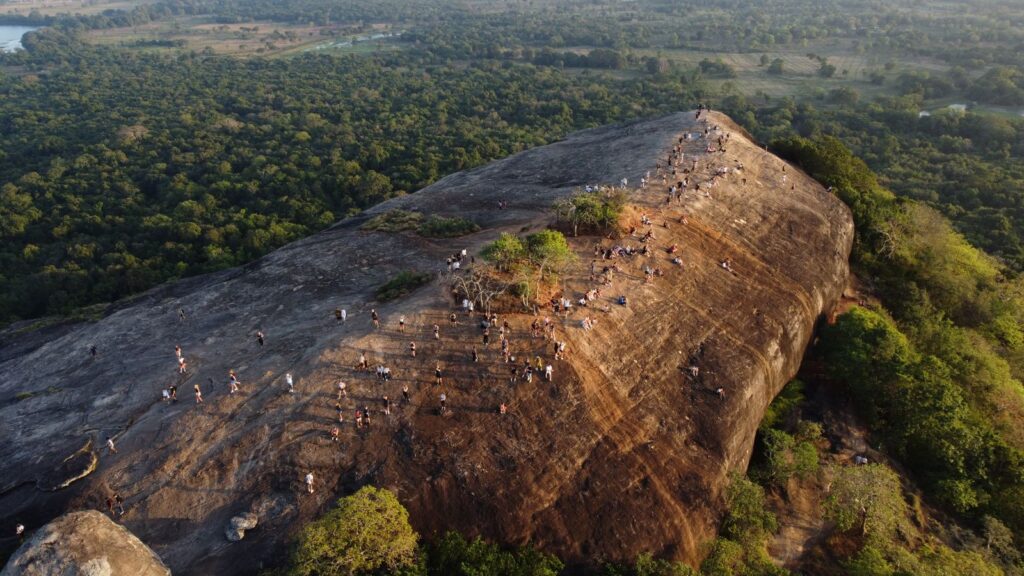
Pidurangala Rock is the hill directly north of Sigiriya, and its summit gives you the photograph most people actually want: Lion Rock, whole, at a distance. The ticket is LKR 1,000, paid on site, and it is not covered by the Sigiriya ticket, so budget for Sigiriya rock climbing and Pidurangala separately.
The walk is short, thirty to forty-five minutes, but the final section is a scramble over boulders that needs both hands. It is not a staircase, and it is a poor choice for anyone with knee trouble or a genuine fear of exposed scrambling.
At the base there is a working temple with a large reclining Buddha, and it asks for covered shoulders and knees. Sunrise is the classic time to be up there, which means a 4:30 start, a torch and shoes with grip.
Many of our guests do both hills in one day: Pidurangala at sunrise for the view, Sigiriya after breakfast for the frescoes. It is the best single day this region offers, and it is the shape I build most often for guests who want Sigiriya rock climbing plus the photograph of it.
Getting to Sigiriya from Colombo, Kandy and Dambulla
Sigiriya sits in the northern Matale District, and every approach is on ordinary A-roads rather than expressway. Sri Lankan road times are consistently longer than the map suggests, so plan the slower number and let Sigiriya rock climbing start when you arrive.
| Starting point | Road time | What that means for the climb |
|---|---|---|
| Colombo | 4 to 5 hours | Leave by 05:00 to climb the same morning |
| Kandy | 2 to 3 hours | The most comfortable base for a day trip |
| Dambulla | 20 to 30 minutes | Closest town with hotels plus the cave temple |
| Habarana | About 15 km | Nearest railway station, then a tuk-tuk |
| Bandaranaike Airport | 3.5 to 4.5 hours | Feasible on arrival day, never on departure day |
Sigiriya rock climbing as a day trip from Colombo is possible but punishing: five hours each way for three hours on the rock. I recommend it only for guests with a genuinely tight schedule, and always with a driver rather than a self-drive car. Tired Sigiriya rock climbing after five hours in a van is how people fall on stairs.
From Kandy it is a good day out. From Dambulla or Habarana it is a half-day. That is why most of our Cultural Triangle itineraries base guests there for two nights and build the region around them.
If you want the rock to be one stop on a longer route, our Sri Lanka Cultural Triangle tour guide covers how Sigiriya fits with Anuradhapura, Polonnaruwa and Dambulla. For the ancient capitals themselves, see the Anuradhapura and Polonnaruwa guide.
For a guided version of this exact day, our Sigiriya day tour from Colombo page lists timings, pickups and what a private driver changes about the schedule.
What to Bring for Sigiriya Rock Climbing
Water first, because there is nowhere above the entrance to buy it. In the dry months, 1.5 to 2 litres per person is the honest number for Sigiriya rock climbing, and more if you start after nine.
- Water, 1.5 to 2 litres per person, carried not left in the van
- Shoes with real grip; the metal stair treads are slippery when wet
- A hat and sunglasses, because the summit has no shade at all
- Sun cream applied before you start rather than on the stairs
- A light rain shell in October and November
- Your passport if anyone in the group is buying a concession ticket
- Cash in rupees for Pidurangala, drinks and the car park
- A small bag that leaves both hands free for the rails
Leave the tripod and the large backpack behind; both are awkward on a one-way staircase with people behind you. Anything that dangles is also interesting to monkeys, and plastic bags are interesting to them in particular.
Hornets, Monkeys and Heat — Safety Rules Nobody Mentions
Sigiriya is a wild site with a staircase running through it. Three hazards account for almost every incident I hear about from guests, and none of them appears anywhere on the ticket you buy for Sigiriya rock climbing.
Hornets nest on the rock face itself. If you pass a nest, stay quiet, keep moving and do not swat at anything. Noise and flapping are what provoke a swarm, and a sting reaction on a staircase is genuinely serious.
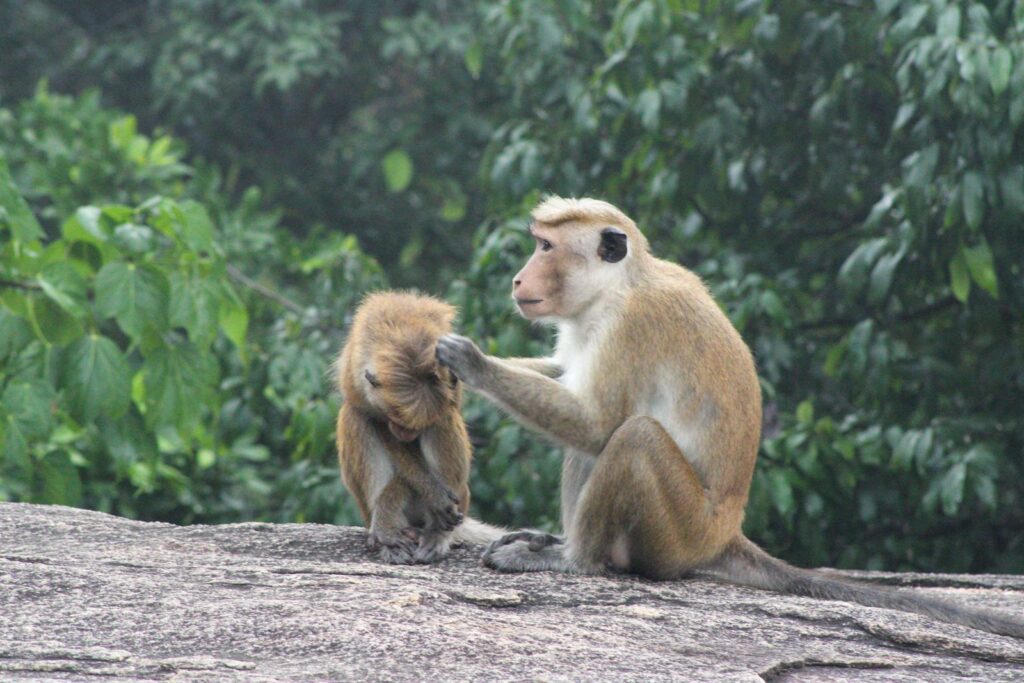
Toque macaques work the terraces and the summit, and they have learned that plastic bags mean food. Do not feed them, do not hold food out for a photograph, and do not leave a bag on a wall while you pose.
Heat is the third and by far the most common. Sigiriya rock climbing at 32 degrees with high humidity dehydrates people faster than they notice, and the exposed final staircase is where it catches them.
Take the rest you do not think you need. Sit in the shade at the lion’s paws for five minutes, drink, and then decide whether the last section of Sigiriya rock climbing is worth it today. That pause prevents most of the bad afternoons I hear about.
Sigiriya for Families, Older Travellers and Non-Climbers
Children usually love it. The steps become a countdown, the lion’s paws are a story with a monster in it, and the summit is a real reward rather than a photo stop. Sigiriya rock climbing is one of the few big-ticket sights that genuinely works for a seven-year-old.
Older travellers with healthy knees do fine as well, and there are handrails on nearly every flight. The exception is the last metal staircase, where the treads are steep and the exposure is honest, and that is where Sigiriya rock climbing sorts people out.
If the full climb is not right for someone in your group, they are not stuck in the car park while everyone else does Sigiriya rock climbing. The water gardens, the museum and the boulder gardens all sit at ground level and all come with the same ticket.
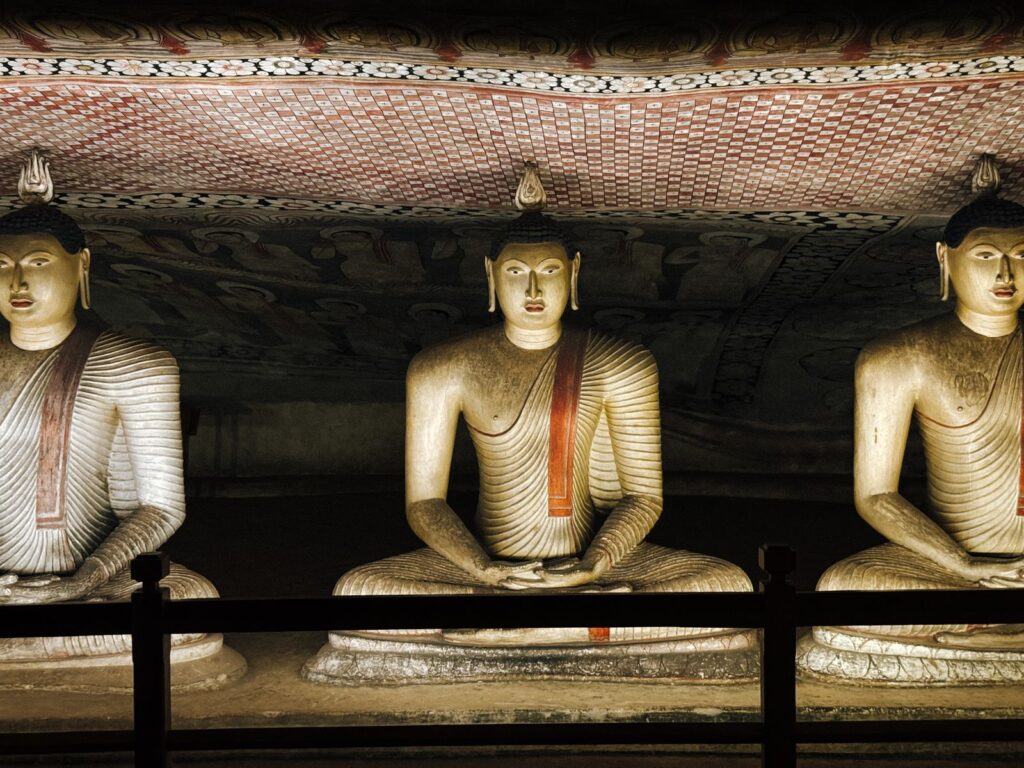
Our standard alternative is Dambulla, twenty-five minutes away, where the cave temple is a covered climb of steps under painted ceilings that rival anything at Sigiriya. Its ticket is LKR 1,500 and it asks for covered shoulders and knees.
Sri Lanka Tourism’s heritage pages are a decent starting point for pairing Sigiriya with the other Cultural Triangle sites on one route.
Sigiriya with a Guide — What You Actually Gain
Sigiriya is one of the few sites in Sri Lanka where a guide changes what you see rather than how fast you walk. Without one, the frescoes are paintings, the Sigiriya mirror wall is a scratched parapet and the summit is a pile of bricks. With one, Sigiriya rock climbing becomes a walk through a political story.
A good guide reads the landscape instead: why the water gardens align to the rock, where the painting gallery sits in the plan, and what the graffiti verses actually say. Ours have walked this route for years and know which staircase backs up first.
They also solve the logistics that eat a morning. Arriving before the coaches, buying tickets without a queue, and knowing when to abandon the summit for a cold drink are things no map tells you about Sigiriya rock climbing.
That is the honest case for guided Sigiriya rock climbing, and it has nothing to do with carrying your bag. The value is timing, context and a driver who has done it four hundred times.
You can see how a private vehicle changes the day on our custom tour itinerary page. If your dates are still open, read the best time to visit Sri Lanka first.
Frequently Asked Questions
How many steps are there at Sigiriya?
About 1,200, spread across the gardens, the boulder terraces, the fresco stairwell and the final metal staircase. The count varies between sources because the spiral staircase to the frescoes is a detour rather than part of the main ascent.
How long does Sigiriya rock climbing take?
Two and a half to three hours for most visitors, gate to gate, including the museum. A fit walker can do it in ninety minutes and a family with young children should plan for four.
Is Sigiriya rock climbing safe?
Yes, with ordinary care. The route is a staircase, but hornets nest on the rock, the heat is real, and the final staircase is exposed. Roughly 1,200 steps with handrails is a fair description of the risk. Most days, Sigiriya rock climbing is a hot walk with one short exposed staircase.
Can you climb Sigiriya at sunrise?
Not reliably. The published opening hours range from 05:00 to 07:00 depending on which official page you read, so a summit sunrise is a gamble. Plan for 06:45 at the counter and treat an early gate as a bonus.
Is Sigiriya suitable for elderly visitors?
For most healthy older travellers, yes. Handrails cover nearly every flight, and the terraces give you somewhere to rest. If knees are the problem, note that descending is harder than climbing and Pidurangala is not an easier swap.
Can children climb Sigiriya?
Yes, and most enjoy it. Children from about six cope well, though the final staircase is slow with short legs. Under-sixes are usually carried on that last section, which is allowed but tiring for the adult.
Can you climb Sigiriya in the rain?
Yes, and the water gardens look better for it. Wet-season Sigiriya rock climbing is quieter too, which is worth something. The metal staircases become slippery, so take them slowly, and come down if there is lightning anywhere near the rock.
What is the Sigiriya entrance fee for foreigners in 2026?
US$35 for an adult, charged in rupees at the Cultural Fund’s daily rate. On 14 October 2026 that rate was 336 rupees to the dollar, which worked out at LKR 11,760. A concession ticket for children aged 6 to 12, SAARC passports and student cards is US$20.
Do I need to book Sigiriya tickets in advance?
No, but it saves a queue in peak season. The Central Cultural Fund sells tickets online, and an order is valid for ninety days before you exchange it for a paper ticket at the counter.
Is Pidurangala better than Sigiriya?
It is better for one specific photograph, because you can see Sigiriya from it. Sigiriya is far better for history, frescoes and a real archaeological site. Doing both in a day is the answer most guests end up preferring. Sigiriya rock climbing in the morning and Pidurangala at sunrise is the reverse order, and that works as well.
Is there a dress code at Sigiriya?
No formal one, because Sigiriya is an archaeological site rather than a working temple. Pidurangala and Dambulla are different: both are active temples and ask for covered shoulders and knees.
Can you fly a drone at Sigiriya?
Not casually. Drones and professional filming need written approval from the Central Cultural Fund in advance, and ordinary photography is included in your ticket. Assume no drone unless you have that letter.
What is the best time of day for Sigiriya rock climbing?
Between seven and nine in the morning, or the first hour the gate opens. The queue at the fresco stairwell is short, the rock has not heated up yet, and the light on the water gardens is at its best.
Plan Your Sigiriya Rock Climbing Day with Amazing Escapes Tours
Sigiriya rewards timing more than fitness. The difference between great Sigiriya rock climbing and a miserable morning is usually fifteen minutes at the gate and a driver who knows where to park.
We are a Sri Lanka based operator, not a reseller. Our drivers have climbed this rock hundreds of times. They know which staircase jams first, and they will tell you honestly whether the summit is worth it on the day.
What a Sigiriya day with us includes:
- A private air-conditioned vehicle and an English-speaking driver-guide
- Pickup from Colombo, Kandy, Dambulla, Habarana or your Sigiriya hotel
- An arrival timed to the opening of the ticket counter, not to a coach schedule
- Honest advice on whether Sigiriya rock climbing suits everyone in your group
- The Pidurangala option at sunrise, with a torch and the temple dress code explained
- The Dambulla cave temple and a Habarana village lunch on the same route
- Airport transfers and a local contact number for the whole trip
Tell us who is climbing and who is not, and we will build the day around that, including the Sigiriya rock climbing timing that suits your group. Start with a free quote through request your custom Sigiriya itinerary today. Our Sri Lanka 7 day itinerary is the shortest route that still gives Sigiriya a proper morning, and our places to visit guide shows where it sits on the map.
About the author: Dhanushika Hewa Paththinige is a Sri Lanka travel expert with over 8 years of experience designing custom tours for international visitors. As the founder of Amazing Escapes Tours, she has walked the Sigiriya staircases in every month of the year and still stops at the mirror wall. Her expertise covers island-wide itinerary design, Cultural Triangle routing, heritage site access and family travel.