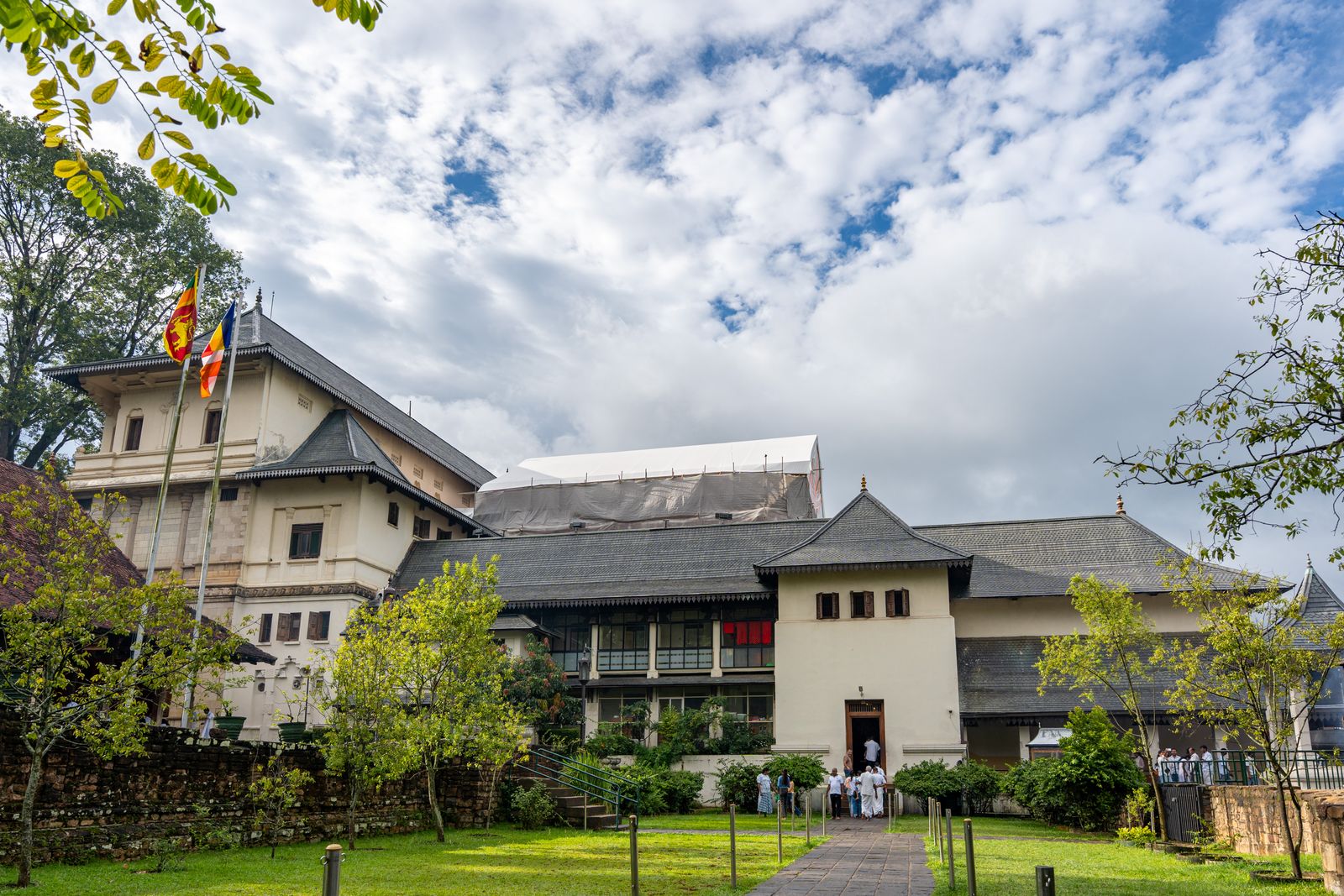
The first time a guard stopped me at a temple gate I had nobody to blame. I was nineteen, in shorts, in Kandy, and the man simply pointed at my knees and then at the sarong table.
Sri Lanka temple rules are not complicated. They are just never written anywhere a visitor reads them before landing, which is why people get turned away holding a paid ticket.
I have taken guests into temples in every province of this island for eight years. This page is the brief I give them the night before, with each rule quoted from the institution that actually enforces it. It is the only page of Sri Lanka temple rules I ask them to read twice.
Every specific detail below comes from the Temple of the Sacred Tooth Relic’s own visitor guidance, the Mahamevnawa monastery’s etiquette page, or Sri Lanka Tourism. Where travel guides repeat a rule the temples themselves deny, I say so plainly.
Sri Lanka Temple Rules — The Quick Answer
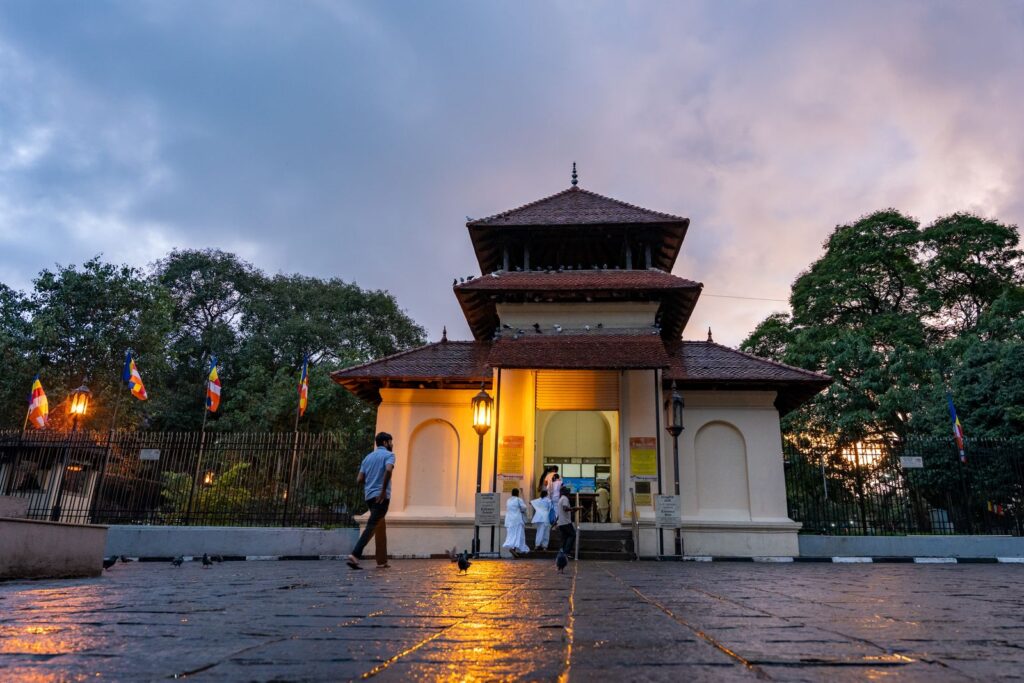
The core of Sri Lanka temple rules is four things. Cover your shoulders, cover your knees, take your shoes off, and lower your voice. That holds at Buddhist temples, Hindu kovils, mosques and churches alike.
Everything else is detail, and the detail is where people get stopped. So the rest of this guide is organised around the moments that actually catch visitors out.
| Rule | What it means in practice |
|---|---|
| Shoulders | No vests, no sleeveless tops, no off-shoulder dresses. A light scarf over a sleeveless top is accepted. |
| Knees | No shorts, no above-knee skirts, no leggings worn as trousers. Trousers or a long skirt work. |
| Shoes | Off before you step into the sacred area, not after. Socks are fine on hot stone. |
| Headwear | Hats and caps off inside. A headscarf worn for religious reasons is a separate matter. |
| Buddha images | Never pose with your back to one, and never climb on a statue or a shrine. |
| Monks | No handshake, no money into a hand. A smile and joined palms is the whole greeting. |
| Photographs | Grounds usually fine, inner shrines often not. Read the sign before you lift the camera. |
| Offerings | Flowers, fruit and incense yes. Polythene and plastic bags are refused. |
That last row surprises almost everybody. Polythene is a genuine prohibition at the Temple of the Tooth, and it is one of the Sri Lanka temple rules I explain most often. I come back to it further down.
Read the table once and you have eighty percent of the Sri Lanka temple rules that matter. The remaining twenty percent is what the rest of the page covers.
What Sri Lanka Temple Rules Are Actually For
A Buddhist temple is not a museum that happens to have a dress code. It is a working place of worship, and the person beside you may be there for a funeral, a blessing or a vow. That single idea explains every one of the Sri Lanka temple rules below.
That reframing does most of the work. Once you treat the site as somebody’s church rather than as a photo location, the Sri Lanka temple rules stop feeling arbitrary.
The Lonely Planet guide to the island puts it in one line worth carrying: do not treat places of worship like tourist sites. It then lists the practical core, which is footwear off and legs and shoulders covered for both men and women.
I add one thing from experience. Arrive early in the morning if you want the temple to itself, because Sri Lanka temple rules are easier to follow when nobody is queuing behind you.
There is also a practical reason behind the quiet. A shrine room carries sound in a way an open courtyard does not, so a normal speaking voice travels the whole length of it. That is a physical fact rather than a Sri Lanka temple rules invention.
The Sri Lanka Temple Dress Code, Decoded
The Sri Lanka temple dress code is applied at the gate, by a person, with a judgement call. That is why two visitors in similar outfits can get different answers on the same afternoon.
The Mahamevnawa monastery’s visitor guidance is refreshingly direct about this. It asks for clothing that covers your shoulders and, if possible, your knees, and notes that a sheer scarf and a sarong can accomplish it.
Its guidance also settles a question guests ask constantly. Many devout Buddhists wear white to a monastery, but there is no expectation that visitors will.
My own reading of the Sri Lanka temple dress code is that it rewards one decision. Dress as though you are meeting somebody’s grandmother, and every gate on the island opens without a conversation. None of the Sri Lanka temple rules ask you to buy anything special.
What to wear at a Buddhist temple
For men, long trousers and a shirt with sleeves is the safe uniform. For women, trousers or a skirt past the knee with a top that covers the shoulder does the same job.
Shorts are the single most common failure. At the Temple of the Tooth in Kandy they are named explicitly in the temple’s own prohibited list, alongside sleeveless and body-revealing attire. It is the first Sri Lanka temple rules clause anybody tests at the gate.
Leggings are a grey area. Worn under a long top they usually pass; worn as trousers with a short top they often do not.
If you are packing for a fortnight of temples, two pairs of light long trousers will do. They carry you through the Sri Lanka temple dress code at every site on this page.
What to wear at a Hindu kovil
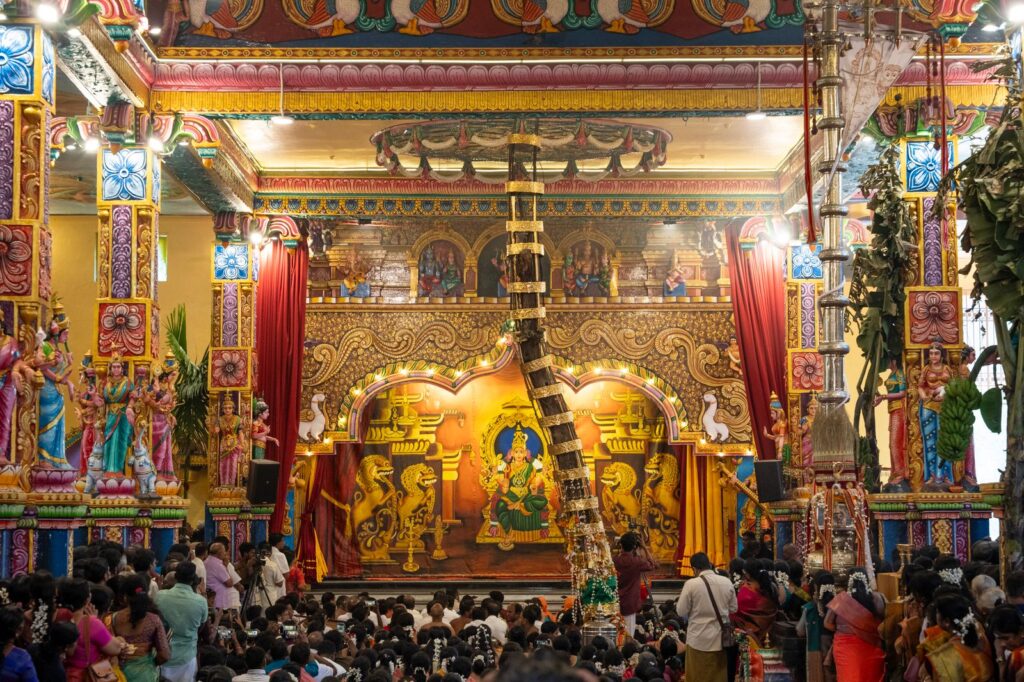
Hindu kovils on the island follow the same shoulders-and-knees baseline, so the same outfit works. The difference is that some inner shrines are restricted to Hindu worshippers, and some require men to remove their shirt before entering.
Look for signs at the inner doorway and ask a priest if there is none. Nobody minds the question, and it is a shorter conversation than being escorted back out. The Sri Lanka temple rules at a kovil are otherwise the same as at a Buddhist shrine.
| Site type | Shoulders | Knees | Shoes | Extra |
|---|---|---|---|---|
| Buddhist temple (major) | Covered | Covered | Off | Hats off, no back-to-Buddha photos |
| Buddhist monastery | Covered | Covered if possible | Off, socks fine | Residential buildings off limits |
| Hindu kovil | Covered | Covered | Off | Some inner shrines restricted |
| Mosque | Covered | Covered | Off | Women cover hair inside |
| Church | Covered | Preferred | Optional | Rarely enforced at the door |
| Ancient ruin with shrine | Covered | Covered | Off at the shrine | Ruins themselves are open ground |
Two sentences of practical advice sit above all of that. Carry a thin sarong and a light scarf, and the Sri Lanka temple dress code becomes a non-event for the rest of the trip.
Temple of the Tooth Dress Code — The Strictest Gate in Sri Lanka
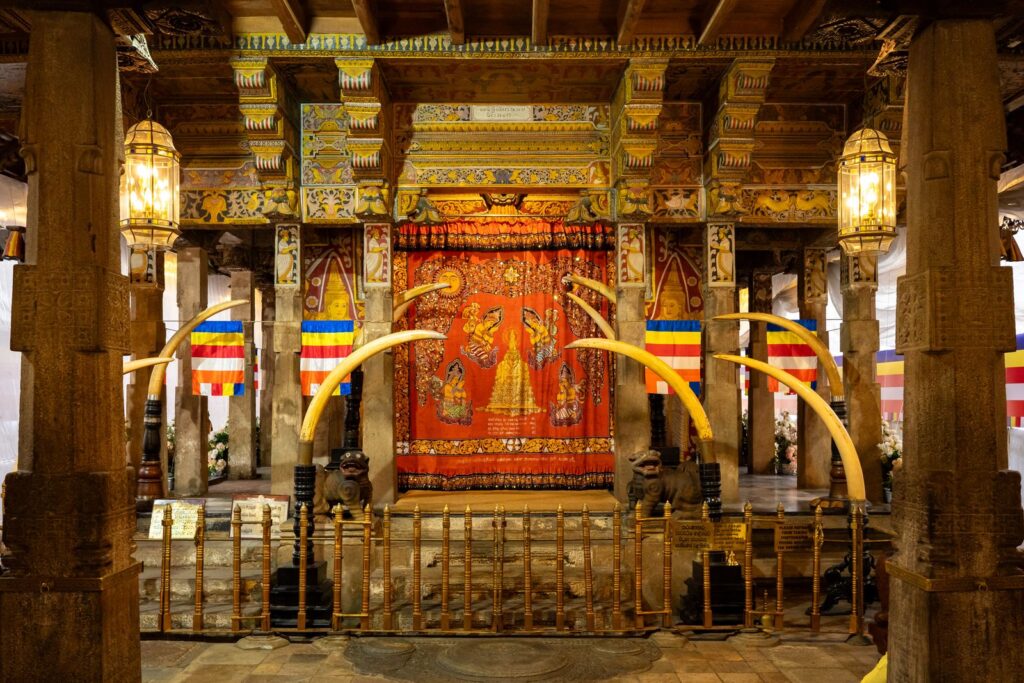
The Temple of the Sacred Tooth Relic in Kandy is the most visited religious site on the island and the least forgiving about clothing. Its own website states that visitors wearing shorts, sleeveless or body-revealing attire are not permitted.
The same page adds the part most guides leave out. Appropriate clothing can be obtained at the entrances, so arriving badly dressed is fixable rather than fatal.
The Temple of the Tooth dress code is still worth getting right before you queue, because the fix costs you time at the busiest hour of the day. Of all the Sri Lanka temple rules on this page, this is the one I check guests for before we leave the hotel.
The temple’s published visitor FAQ is the source for everything in this section. It is a short page, and reading it before you go is the single most useful ten minutes of temple preparation on this island.
The booth, the token and the scanner
Shoes, bulky luggage and non-essential items go to a reception booth, and you get a token in exchange. The temple runs two separate booths, one for local devotees and one for foreign visitors.
Every person entering is screened, and every item including offerings is checked with scanning machines. Budget a few minutes for that at peak times.
Two prohibitions sit on the same page and surprise people. Pets are strictly prohibited across the premises, and harmful materials such as polythene and plastic should not be brought in at all. Both are Sri Lanka temple rules that get enforced at the door rather than explained.
What the ticket actually covers
Tickets are issued by machines installed at the temple itself. The temple states plainly that tickets or fees issued by other individuals or institutions are not valid, which is a sentence that exists because touts still sell them.
| Visitor | Published fee |
|---|---|
| SAARC country passport holders | LKR 2,500 |
| Thailand and Myanmar passport holders | LKR 2,500 |
| All other nationalities | LKR 3,000 |
One ticket covers five places on the same premises. The temple names them as the Temple of the Tooth Relic itself, the Dalada Museum, the World Buddhist Museum, the Tusker Museum and the Royal Elephant Stable.
Most visitors see the shrine, photograph the lake and leave, which means they have paid for four museums and skipped all of them. I would give that museum circuit an hour if you have it.
The temple is open daily from 5.30am to 8.00pm local time. Those are the temple’s own published hours, not a guide’s estimate.
Three services run every day. The early morning service is 5.30am to 7.00am, mid-morning is 9.30am to 11.00am, and the evening service is 6.30pm to 8.00pm.
Stand at the back during a service rather than in the middle of it. Whether or not you are Buddhist, the Sri Lanka temple rules about not obstructing worshippers apply hardest in that half hour. Let worshippers through and you will never be asked to move.
One ritual is worth planning a trip around. Nanumura Mangallaya, the bathing of the relic with a herbal preparation, takes place every Wednesday at 9.30am.
If you would rather have Kandy handled for you, our Kandy tour packages are timed around the services rather than against them.
Shoes, Socks and Hats — The Sri Lanka Temple Rules People Forget
Shoes come off before you enter the sacred area, and every source I trust states it. The Lonely Planet guidance lists removing footwear first, and the monastery guidance says the same.
The monastery page carries a detail nobody plans for. The ground is often hot, so socks are acceptable and make barefoot stone bearable at midday.
There is also a medical exception, and it is handled by speaking up. The guidance asks anyone unable to remove their shoes for serious medical reasons to inform anyone who asks, which is a far easier conversation than you expect.
Hats come off inside. That is one of the Sri Lanka temple rules visitors genuinely forget, and it is enforced at the big sites even though it is quoted less than the shoes rule.
Where do shoes go? At the Temple of the Tooth they go to the booth with a token. At smaller temples they go into a rack or a pile at the entrance, unattended.
Take a cloth bag for them if you are precious about your shoes. It also solves the mud problem in the wet season, which is the version of the Sri Lanka temple rules nobody writes about. The rules say nothing about where shoes go, so every temple solves it differently.
One more thing on the ground. Walk around a stupa rather than across its platform, and treat a low wall or a rope line as a boundary rather than a suggestion.
None of these are exotic. They are the Sri Lanka temple rules a local child learns before being taught to read, which is why nobody thinks to write them down.
Photography and Phones Inside a Temple
The monastery guidance is more permissive than most travel blogs suggest. Unless something is posted, photography is generally acceptable.
The one hard limit is stated in the same breath. Do not pose with your back towards sacred objects such as Buddha statues.
That single sentence explains dozens of signs you will see at major temples. It is not photography that is banned so much as the specific pose that reads as disrespect.
In eight years I have never seen a guard object to a camera held properly. I have seen plenty of objections to a person standing on a plinth. Both of those are the Sri Lanka temple rules a sign is trying to state.
Sri Lanka temple etiquette for cameras
The reliable Sri Lanka temple etiquette for cameras is a two-step check. Read the sign at the entrance, then read the sign at the inner shrine, because the two frequently differ.
Grounds and exteriors are almost always fine. The Sri Lanka temple rules tighten only where worship is happening, which means the inner chamber and the room holding the relic.
Never photograph people mid-prayer, and never photograph a monk without asking. I once watched a guide talk a visitor out of photographing a family at a funeral shrine.
Phones are the other half of this. The monastery asks visitors to turn off the ringer at shrines and inside buildings, and to step away if a call is unavoidable.
A phone held up during a service is the modern version of talking loudly. It reads as worse than it is, which is exactly why it irritates the people beside you.
So the Sri Lanka temple rules on cameras come down to two words. Ask first.
Meeting a Monk Without Getting It Wrong
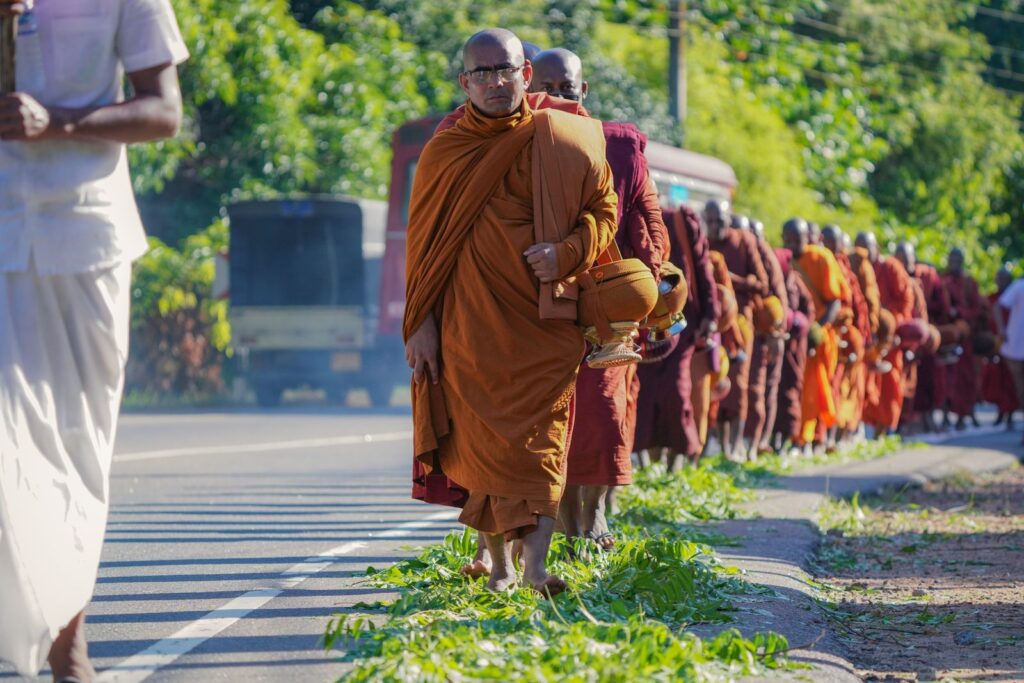
Monks do not shake hands, and that is the one rule that catches Western visitors most often. The monastery’s own guidance says to greet a monk with a smile, or with your hands together as if praying.
Buddhists will usually make a full bow to a monk or a nun. That is not expected of visitors, which means a small nod and joined palms is complete and correct. It is the whole of the Sri Lanka temple rules regarding monks, and the rest is courtesy.
Do not offer money to a monk directly. Where you would like to give, use the clearly marked donation boxes.
That prohibition is a monastic rule rather than a local custom, so no amount of friendly insistence changes anything. Put the note in the box and the Sri Lanka temple rules are satisfied.
Residential buildings inside a monastery are off limits to the public and are usually marked. If a path looks like it leads to somebody’s room, it probably does. That is one of the Sri Lanka temple rules no sign will spell out for you.
What you can do is broader than most visitors assume. The guidance explicitly welcomes visitors to meditate in the shrine rooms, chant quietly, or make their own offerings.
Children are welcome too, and are expected to be children. The only ask is supervision, because running and shouting in a shrine bothers the people praying in it.
Most of the Sri Lanka temple rules concerning monks are really rules about not making somebody’s day harder. A greeting and a step back cover all of them.
Offerings, Flowers and What Gets Refused at the Gate
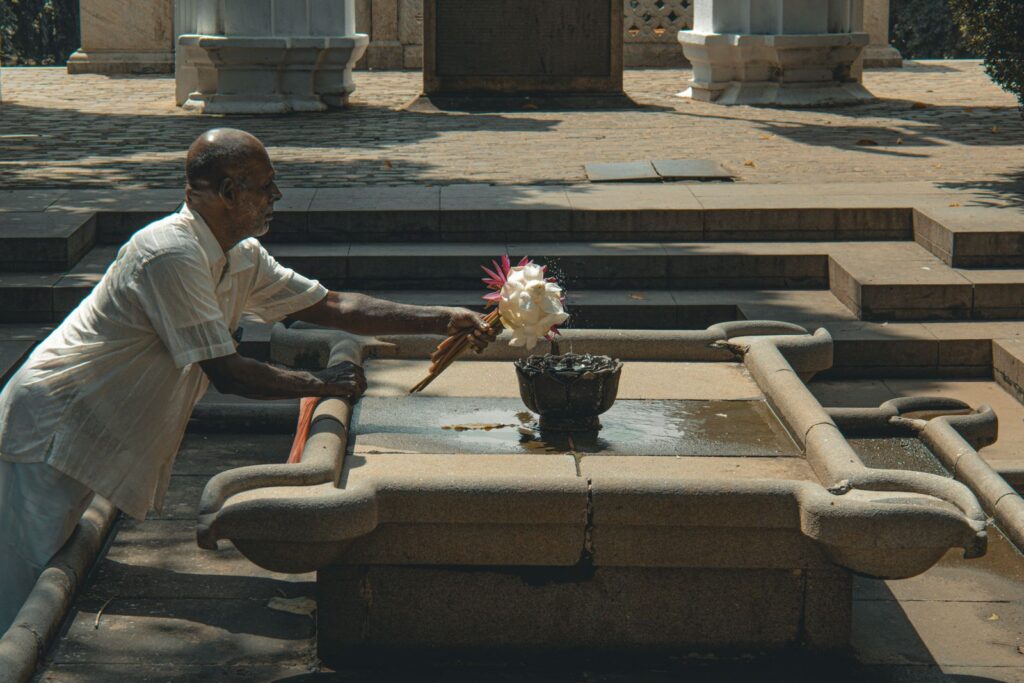
Flowers, fruit and incense are the ordinary offerings, and you can buy them outside most major temples for small money. Lotus and jasmine are the usual choices, and a vendor near the gate will assemble a tray in a minute.
The Temple of the Tooth goes further than most and states it openly. Offerings should not arrive in polythene bags or plastic bags and containers. This is where the Sri Lanka temple rules stop being about clothing and start being about what you carry in.
Bring your own cloth bag or buy the prepared tray, and that is the whole fix. It is an enforced rule rather than a suggestion, and it exists because plastic ends up on the temple grounds.
Do not hand cash to a monk, and do not leave an offering in a place that has no business holding one. A shrine has a ledge or a table for it; a wall does not.
If you want to photograph your offering, do it before you place it. Afterwards it belongs to the shrine rather than to you, which is a Sri Lanka temple rules point about the shrine rather than your camera.
One quiet courtesy worth knowing. If somebody is mid-prayer, wait the ten seconds rather than reaching past them, and the Sri Lanka temple rules about not obstructing worship are covered.
There is a small environmental point in this too. The polythene restriction is part of a wider push to keep plastic off sacred ground, and the Sri Lanka temple rules around offerings follow it.
Buddhist Temple Etiquette Sri Lanka — Six Things Travel Guides Get Wrong
Buddhist temple etiquette Sri Lanka visitors read about usually comes with a thick layer of advice that arrived from India, from Thailand, or from a blog repeating another blog. Some of it is simply not local practice.
The clearest statement I have found is on the Mahamevnawa monastery’s own etiquette page. It lists the clockwise walking rule, the careful-hand rule and the right-foot-first rule, and says plainly that these are not part of Sri Lankan Buddhist culture.
That is a monastery telling visitors to stop worrying, not a travel writer guessing. I quote it because guests arrive anxious about exactly these things, and it removes the anxiety in one sentence.
Clockwise, right hand, right foot
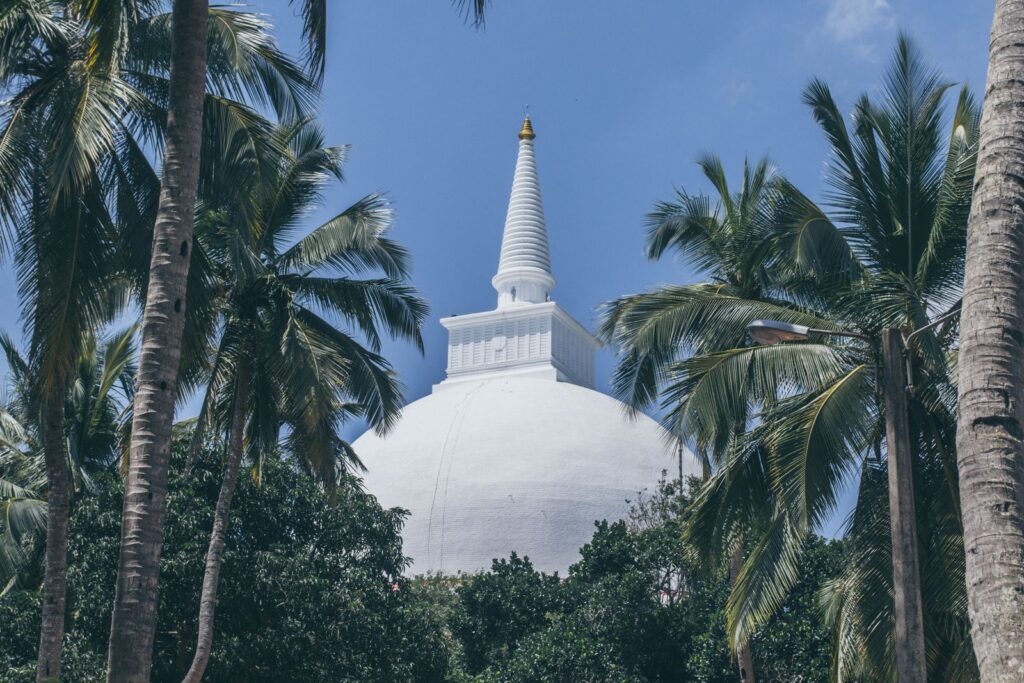
The clockwise custom does exist in Sri Lanka at stupas, where worshippers walk around the dome with it on their right. It is an act of veneration rather than a rule you can fail.
Follow the flow of the crowd and you will get it right without thinking. Nobody at a Sri Lankan temple is counting which hand held the flowers.
The right-hand-only food rule is South Asian hospitality across many countries, not a temple gate test. Treating it as an item of Sri Lanka temple rules is how guides make visitors nervous for no reason. Take a plate with your left hand and the consequence is a moment of awkwardness rather than an incident.
So the honest version of this section is short. The Sri Lanka temple rules that get enforced are the four at the top of this page, and the rest is manners.
I bring this up because I have watched visitors spend a whole morning anxious about the wrong thing. The Sri Lanka temple rules worth worrying about are printed at the gate, not whispered in forum threads.
Sri Lanka Cultural Etiquette Beyond the Temple Gate
Sri Lanka cultural etiquette outside a temple is mostly the same instinct applied without a gate. Cover up more than you would at home, keep public affection restrained, and do not put your feet up on anything anyone else uses.
The feet rule has a real basis. Pointing the sole of your foot at a person, an image or an altar is the one gesture that genuinely lands badly here.
Touching somebody’s head is in the same family, and so is turning your back on a sacred image to pose. Neither of those is a Sri Lanka temple rules item, since they apply on a bus as readily as at a shrine. Neither happens by accident often, but both are worth knowing.
Public displays of affection read as more private here than in Europe. A couple holding hands on a beach is fine; more than that draws looks you would rather not have.
Shoulders on the street are a separate matter from shoulders in a temple. Beachwear belongs at the beach, and a cover-up for the walk back to the road is the practical version of the Sri Lanka cultural etiquette visitors actually notice.
The Sri Lanka temple rules and the wider cultural etiquette share one root. Neither asks you to be devout; both ask you to be unremarkable, which is a much smaller favour.
Poya days — what actually changes
Every full moon is a Poya day, a public holiday in Sri Lanka, and temples fill with families dressed in white from before dawn. Sri Lanka Tourism maintains the festival calendar if you want dates before booking.
Because it is a public holiday, government offices, banks and licensed liquor outlets close. Hotels plan around it, and so should you. The Sri Lanka temple rules do not change on a Poya day, but the crowds around them do.
The temples on a Poya day are wonderful and completely packed. If your reason for going is atmosphere, go; if it is photographs of empty corridors, go on a weekday morning instead.
One small courtesy on Poya. Dress slightly more conservatively than you would otherwise, because the Sri Lanka temple rules still apply while everybody around you is dressed for worship.
If a festival is the reason for your trip, the Kandy Esala Perahera guide covers the biggest Poya-adjacent spectacle on the island.
Sri Lanka Temple Rules Site by Site
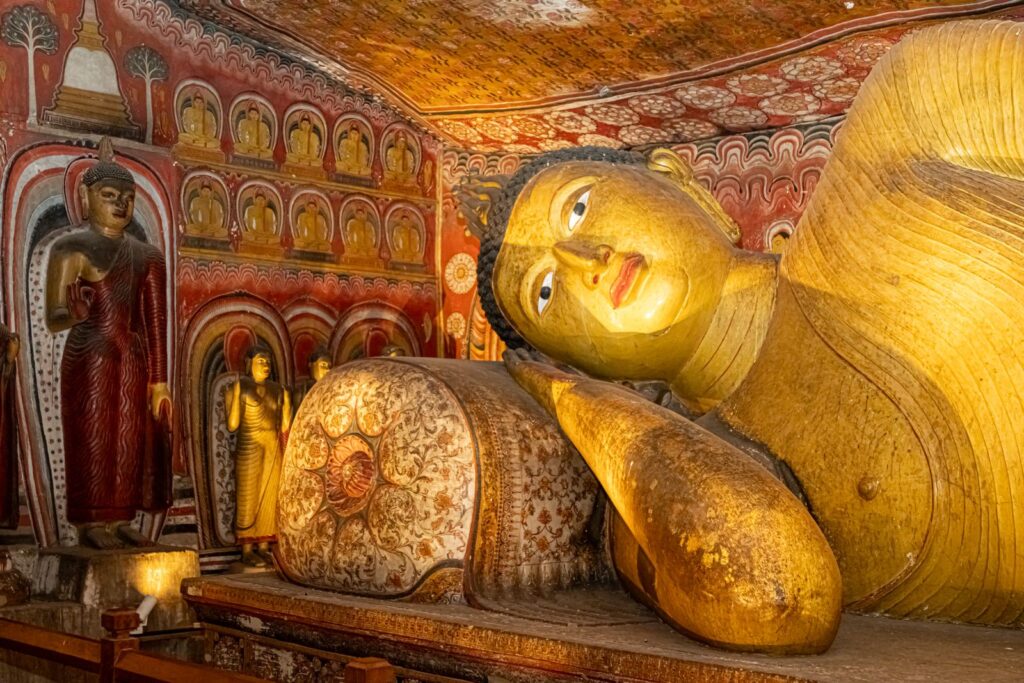
The four rules travel everywhere, but the gate at each site has its own habits. This is the Sri Lanka temple rules table I would stick on the fridge if I could.
| Site | What to expect at the gate |
|---|---|
| Temple of the Sacred Tooth Relic, Kandy | Strictest on the island. Booth and token for shoes, screening, no shorts or sleeveless, clothing available at the entrance. Machines issue tickets, so refuse anything from a person. |
| Golden Temple, Dambulla | Shoulders and knees enforced, shoes off at the base of the climb. The stairway is in full sun, so light long trousers beat denim. |
| Sigiriya and Pidurangala | The rock and the fortress are open ground, but Pidurangala’s summit temple is a working shrine. Cover up for the last stretch regardless of the climb. |
| Ancient cities of the Cultural Triangle | Ruins themselves are open. Any active shrine inside them, and every dagoba platform, expects shoulders, knees and bare feet. |
| Kelaniya and Mihintale | Active pilgrimage sites rather than tourist stops. Expect crowds on Poya and a fuller dress code than the ruins nearby. |
| Kovils in Galle and the east coast | Shoulders and knees covered, shoes off, some inner shrines restricted to Hindu worshippers. |
If you only remember one row, remember the first one. The Temple of the Tooth applies the Sri Lanka temple rules more firmly than anywhere else you will visit.
Two guides go deeper on the sites in that table. The Sigiriya rock climbing guide covers the Pidurangala summit temple, and the Anuradhapura and Polonnaruwa guide covers the dagoba platforms.
The practical reading of the table is simple. Dress for Kandy and you are dressed for the whole island, which is why I pack on that assumption.
Families, Elders and Travellers with Mobility Needs
Small children are genuinely welcome, and the monastery guidance says so directly. The ask is that they are supervised, because a shrine is not a playground for the family beside you.
Bare feet are the hardest part for older visitors, and there is no rule against carrying sandals to the edge of the sacred area. The Sri Lanka temple rules about footwear are the only ones that reliably stop an older traveller. Put shoes back on the moment you step off it.
The Temple of the Tooth publishes a service worth knowing about. Visitors with special needs can call the administration office to arrange transport from the main entrance and use of the lift.
The number published for that is 081 223 4226, and the general administration line is +94 81 220 4867. Call ahead rather than arriving and hoping.
For anyone wanting to meet the Diyawadana Nilame, the temple’s chief custodian, his office receives visitors on Wednesdays by prior appointment through the administration division.
Buggies and wheelchairs cope with the flat courtyards at most major sites but struggle with the stairways at Dambulla and Mihintale. Tell us which of those is on the plan and the Sri Lanka temple rules stop being the constraint.
One accommodation is worth asking for, and it is rarely offered unprompted. A slow, shaded route to the shrine suits most older visitors better than the shortest one.
A Checklist to Run Before You Leave the Hotel
This is the list I send guests the night before a temple day. It takes two minutes and prevents every failure I have watched happen. Think of it as the Sri Lanka temple rules compressed into seven lines.
- Trousers or a skirt past the knee, and a top with sleeves
- A thin sarong and a light scarf in the day bag
- Socks, if barefoot stone is going to be a problem
- A cloth or paper bag for shoes, and no polythene anywhere in the bag
- A shoulder cover for the beach-to-temple walk
- Shoes you can slip off in one motion
- No food in plastic containers, and no pets in the vehicle
That is the whole of it. The Sri Lanka temple rules that matter fit on a card, which is the point I make to every guest who worries about offending somebody.
Run it once per trip rather than once per temple. The Sri Lanka temple rules do not change between Kandy, Dambulla and the coast.
Frequently Asked Questions
What are the basic Sri Lanka temple rules?
Cover your shoulders, cover your knees, remove your shoes and keep your voice down. That baseline applies at Buddhist temples, Hindu kovils, mosques and churches, with small differences at each. Everything else on this page is detail hanging off those four Sri Lanka temple rules.
Can I wear shorts to a temple in Sri Lanka?
Not at major temples. The Temple of the Tooth names shorts in its prohibited list, and Dambulla enforces the same standard at the door.
What is the Temple of the Tooth dress code exactly?
Shorts, sleeveless tops and body-revealing clothing are not permitted. The temple adds that appropriate clothing can be obtained at the entrances, so a sarong solves it on arrival.
Do I have to take my shoes off at every temple?
Yes, before you enter the sacred area. Socks are acceptable, and anyone who cannot remove shoes for serious medical reasons is asked simply to tell the person who asks.
Is it rude to take photographs inside a temple?
Usually not on the grounds. The specific prohibition is posing with your back to a Buddha statue, and inner shrines often post their own limits.
How do I greet a monk?
A smile, or your hands together as if praying. Monks do not shake hands, and a full bow is a Buddhist practice rather than something expected of visitors.
Can I give money to a monk?
No. Use the clearly marked donation boxes instead, which is a monastic rule rather than a local preference.
Is it true I must walk clockwise around a temple?
At stupas, worshippers walk with the dome on their right, and following the crowd is the easy way to match. The Mahamevnawa monastery states that clockwise walking, careful-hand and right-foot rules are not part of Sri Lankan Buddhist culture.
What should I wear to a Hindu kovil in Sri Lanka?
The same as a Buddhist temple: shoulders and knees covered, shoes off. Some inner shrines are restricted to Hindu worshippers, and some ask men to remove their shirt.
Are temples busier on Poya days?
Much busier. Poya is a monthly public holiday, so temples fill from before dawn and licensed liquor outlets and government offices close.
What happens if I arrive badly dressed?
At the major sites you will be offered clothing at the entrance, sometimes free and sometimes for hire. Carry a sarong and you never find out which.
Do the Sri Lanka temple rules apply at ancient ruins?
The ruins themselves are open ground. Any active shrine within them, and every dagoba platform, expects covered shoulders, covered knees and bare feet.
Plan Your Temple Visits with Amazing Escapes Tours
Temple days go wrong on timing far more than on clothing. Arriving at the Temple of the Tooth at eleven in the morning means queueing through a service in full sun, and no sarong fixes that.
We are a Sri Lanka based operator, not a reseller. Our drivers know which gate is quietest at which hour, and they will tell you honestly when a temple is worth skipping on a Poya day. They know the Sri Lanka temple rules at each site we visit, which is why the sarong lives in the car.
What a temple day with us includes:
- A private air-conditioned vehicle and an English-speaking driver-guide
- Pickups from Colombo, Kandy, Dambulla, Habarana, Galle or your hotel
- A sarong and shoulder cover kept in the vehicle for every guest
- Arrival timed around a thewawa rather than against it
- The museum circuit at Kandy included in the same visit
- A route that pairs each temple with the ruins or kovil nearby
- Airport transfers and a local contact number for the whole trip
Tell us which temples matter to you and we will build the days around the services rather than around a coach schedule. Start with a free quote through request your custom temple itinerary today.
Our Cultural Triangle guide covers the ancient cities in the same frame, and the Temple of the Tooth Relic guide goes deeper on Kandy than this page can.
If you would rather design the whole trip around religious sites, our custom tour itinerary service starts with the temples you care about and builds the driving days around them.
Knowing the Sri Lanka temple rules is the easy part. Knowing which gate is quiet at nine in the morning is the part that takes eight years.
About the author: Dhanushika Hewa Paththinige is a Sri Lanka travel expert with over 8 years of experience designing custom tours for international visitors. As the founder of Amazing Escapes Tours, she has visited temples in every province of the island and still carries a sarong in the car. Her expertise covers island-wide itinerary design, Cultural Triangle routing, religious site access and family travel.
1 Comment
Comments are closed.
Kandy Esala Perahera 2026 - Dates, Tickets & Guide
[…] this is your first temple visit, read the Sri Lanka temple rules first — the perahera crowds make the dress code and footwear etiquette much harder to get right […]